Somewhere in your chest, several times a minute, a small cluster of cells fires a precise electrical spark that tells your heart when to beat. In atrial fibrillation, that orderly signal dissolves into noise — and for millions of people, it happens without a single symptom to warn them.
Atrial fibrillation, or AFib, is the most common sustained heart rhythm disorder in the world. It is also one of the most quietly consequential. Left unrecognized, it raises the risk of stroke roughly fivefold and can slowly weaken the heart over years. Yet a large share of people who have it feel nothing at all, or dismiss the occasional flutter as stress, caffeine, or a bad night's sleep.
For most of medical history, the problem was not treatment — effective therapies exist — but detection. AFib often comes and goes, and a heart that misbehaves at 2 a.m. tends to behave perfectly during a ten-minute clinic visit at noon. That detection gap is precisely where a new generation of wearable sensors has begun to make a measurable difference.
1. What atrial fibrillation actually is
A normal heartbeat begins in the sinoatrial node, a natural pacemaker in the upper right chamber of the heart. It sends a clean electrical wave across the two atria, prompting them to contract and push blood into the ventricles below. The result is the steady, organized rhythm a doctor hears through a stethoscope.
In atrial fibrillation, that single coordinated wave is replaced by chaotic, disorganized electrical activity firing from many sites in the atria at once — often more than 300 impulses per minute. The atria no longer contract in a unified squeeze; they quiver, or fibrillate. The result is a heartbeat that is irregular and frequently rapid, with no discernible pattern from one beat to the next.
Paroxysmal versus persistent
AFib is not a single fixed state. In its earliest and most common form, paroxysmal AFib, the abnormal rhythm starts suddenly and stops on its own, usually within a day or two, before the heart slips back into normal rhythm. These episodes can be minutes long or hours long, and they may be separated by weeks or months of completely normal beats.
When the rhythm no longer self-corrects and lasts longer than seven days — or requires medical intervention to reset — it is termed persistent AFib. Over time, paroxysmal AFib tends to become more frequent and longer-lasting, a progression captured in the clinical adage that "AFib begets AFib." The longer the heart spends in the abnormal rhythm, the more its electrical and structural properties adapt to sustain it.
2. Why it is dangerous
The danger of AFib is mostly indirect, which is part of why it is so easy to underestimate. When the atria quiver instead of contracting, blood no longer flows briskly through them. It can pool, particularly in a small pouch called the left atrial appendage, and stagnant blood tends to clot.
If a clot forms there and is then ejected into the circulation, it can travel to the brain and block an artery, causing an ischemic stroke. This is why AFib is associated with roughly a fivefold increase in stroke risk. Strokes caused by AFib also tend to be more severe and more disabling than other strokes, because the clots involved are often larger.
There is a second, slower harm. A heart that beats too fast and irregularly for long stretches becomes a less efficient pump. Over months and years, this can contribute to heart failure, a condition in which the heart struggles to meet the body's demand for blood. AFib and heart failure frequently coexist and worsen one another.
The cruelty of atrial fibrillation is that its most serious consequence — a stroke — is often the first symptom a person notices. The rhythm itself can be silent for years while the underlying risk quietly accumulates.
3. The problem of the silent, intermittent rhythm
Surveys of people newly diagnosed with AFib consistently find that a substantial fraction — by many estimates around a third, and in some studies more — had no symptoms at all when their arrhythmia was discovered. When symptoms do occur, they are easy to rationalize: palpitations, a fluttering or pounding chest, breathlessness, fatigue, or light-headedness that comes and goes.
The intermittent nature of paroxysmal AFib compounds the difficulty. A standard electrocardiogram (ECG) in a clinic captures only a few seconds of heart activity. If the heart happens to be in normal rhythm during that window — which is likely if episodes are brief and infrequent — the ECG reads as perfectly normal. Even a 24- or 48-hour Holter monitor can miss an arrhythmia that surfaces only once a week.
This is the central diagnostic puzzle of AFib: the condition is defined by episodes that are, almost by design, unlikely to be present at the exact moment of measurement. Catching it has historically been a matter of luck and timing as much as medicine.
4. How wearables detect it
Wearable devices change the odds by doing something a clinic cannot: watching the heart continuously, in the background, across ordinary life. They do this in two complementary stages — screening and confirmation — and the distinction between the two is essential.
Stage one: photoplethysmography
The first stage relies on photoplethysmography, or PPG — the same green-light optical sensor that tracks your heart rate on the back of a smartwatch. PPG works by shining light into the skin and measuring subtle changes in how much is absorbed as blood pulses through the vessels of the wrist. From this, the device can infer the timing of each heartbeat.
In atrial fibrillation, those intervals between beats become irregular in a characteristic, patternless way. Algorithms can analyze the variability of pulse-to-pulse timing during quiet moments — typically when you are still or asleep — and flag a rhythm that looks suspiciously like AFib. Because PPG runs passively and constantly, it can sample the heart thousands of times over days, dramatically improving the chance of catching an intermittent episode.
Stage two: single-lead ECG
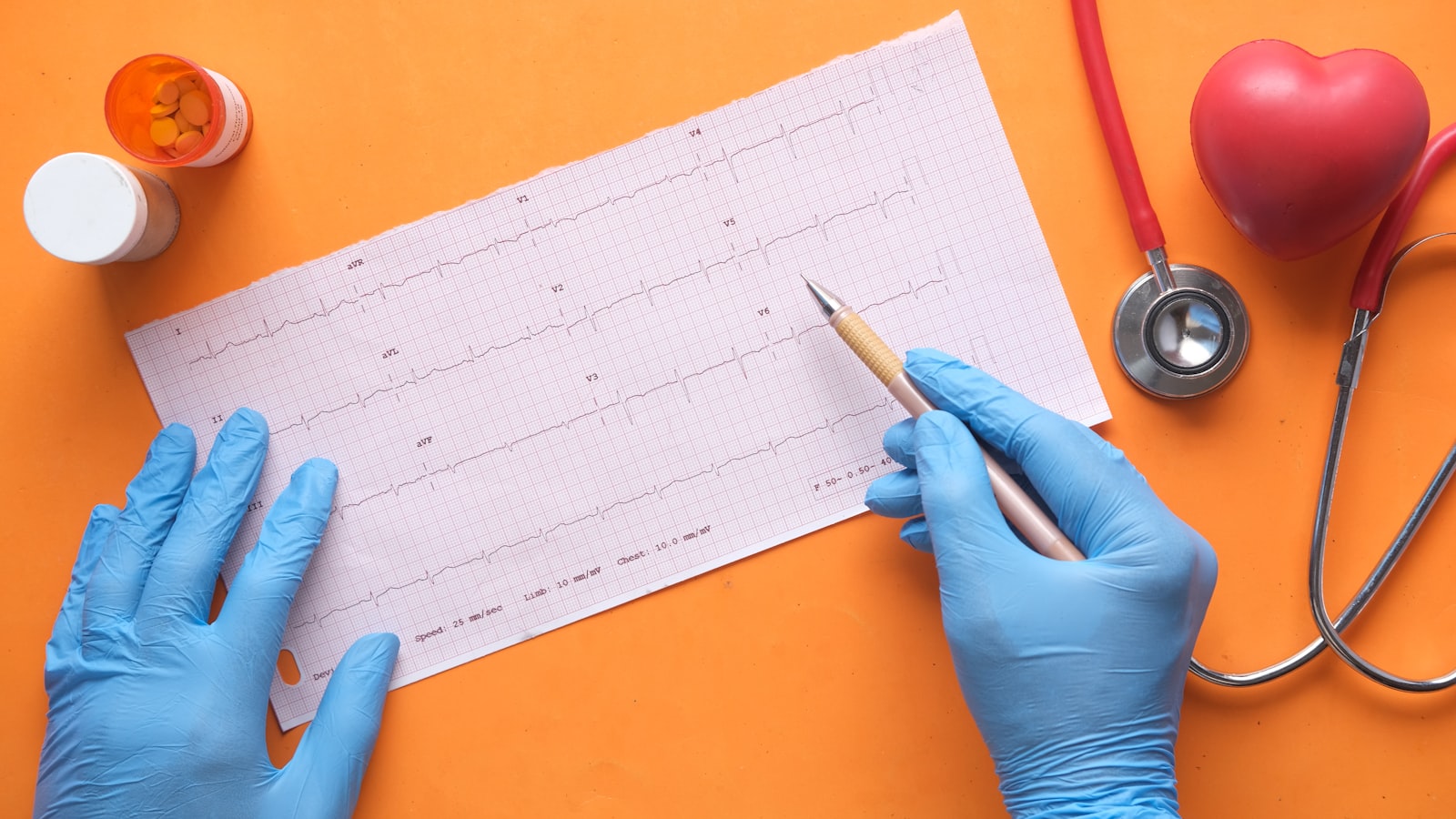
PPG is powerful for screening but cannot, on its own, diagnose AFib. That requires looking at the heart's actual electrical signal. Many modern wearables now include an on-demand single-lead ECG, taken by placing a finger on the watch to complete a circuit across the body. This records a short electrical tracing — a simplified version of the clinical test — that a person, and a clinician, can review for the absence of the regular electrical landmark that vanishes in AFib.
The scale at which this can work was demonstrated by the Apple Heart Study, which enrolled more than 400,000 participants. The study found that PPG-based irregular-rhythm screening could identify people likely to have AFib who could then pursue confirmatory testing. Crucially, only a minority of those who received a notification and went on to ECG monitoring had AFib confirmed — a result that underscores both the promise and the limits of screening at scale.
~5×
Increase in stroke risk associated with untreated AFib
~1 in 3
People with AFib who have no noticeable symptoms
400,000+
Participants in the Apple Heart Study of wearable screening
5. Who is at risk
Atrial fibrillation is not random. A well-established set of factors makes it more likely, and many of them are common, cumulative, and partly modifiable.
Age is the single strongest driver. AFib is uncommon before 50 and rises steeply thereafter, becoming substantially more prevalent in people over 65 as the heart's tissue gradually changes with time. High blood pressure is the most common treatable contributor, because chronic hypertension stretches and stiffens the atria, creating the kind of altered tissue in which fibrillation takes hold.
Obstructive sleep apnea — repeated pauses in breathing during sleep — is a strong and frequently overlooked risk factor, which is one reason AFib episodes so often surface at night. Alcohol is another, with both heavy drinking and, for some people, even moderate intake capable of triggering episodes, a phenomenon long known as "holiday heart." Obesity, diabetes, thyroid disorders, and existing heart disease round out the list. The factors compound: someone with several carries considerably more risk than the sum of any one alone.
Relative likelihood of AFib by contributing factor
Risk factors are illustrative and cumulative; they compound rather than act in isolation.
6. What to do if you get an alert
A notification from a wearable that says it has detected signs of an irregular rhythm can be unsettling. The most useful first response is to understand exactly what it is — and what it is not.
It is a screening signal, not a diagnosis. A wearable alert means the device observed pulse patterns or an ECG tracing consistent with AFib; it does not, by itself, confirm that you have the condition. False positives happen, and so do false reassurances. The correct next step is to capture and save the data — record an on-demand ECG if your device offers one, ideally while symptoms are present — and bring it to a doctor.
A clinician can then arrange confirmatory testing: a standard 12-lead ECG, or extended monitoring with a Holter or patch monitor worn for days or weeks to catch an episode on a medical-grade device. If AFib is confirmed, treatment is well established and effective, typically combining stroke prevention, rhythm or rate control, and attention to the underlying risk factors. What matters is that the loop closes — that a wearable's signal becomes a clinical answer rather than a source of anxiety or false comfort.
- Screening — a passive or on-demand check that flags a heart rhythm as possibly abnormal and worth investigating; it estimates likelihood, not certainty.
- Confirmation — a medical-grade recording, interpreted by a clinician, that establishes whether AFib is genuinely present.
- Diagnosis — the formal clinical determination, made by a doctor using confirmed evidence, that then guides treatment and stroke-prevention decisions.
7. From single readings to continuous awareness
The deeper shift wearables represent is not any single measurement but a change in tempo. A clinic visit is a snapshot; a wrist-worn sensor is a slow, patient film of the heart across ordinary days and nights. For a condition that hides between appointments, that continuity is the whole point — it turns an arrhythmia that surfaces once a fortnight from something almost impossible to catch into something a device is statistically likely to witness.
This is the principle behind Aura Clarus. Passive PPG monitoring runs quietly in the background, building a sense of your normal rhythm and noticing when pulse patterns drift toward the irregular signature of AFib. When something looks unusual, an on-demand single-lead ECG lets you capture a tracing in the moment and carry it to a clinician. The aim is not to replace the doctor or hand anyone a diagnosis — it is to surface a question early and put real data behind it, so that care can begin before a silent rhythm has its first loud consequence.
Used this way, the wearable is a bridge, not a verdict. It widens the window in which AFib can be noticed, and it shifts the moment of discovery away from the emergency room and toward an ordinary, manageable conversation.
The heart keeps its own time, beat after beat, mostly without asking for our attention. The promise of continuous monitoring is simply that when its rhythm starts to falter, someone — or something — is finally paying attention before it is too late to act.
This article is published by Adarna Inc. for educational and informational purposes only. It does not constitute medical advice. Consult a qualified healthcare professional before making any health-related decisions.