Anxiety rarely announces itself as a single thought. It arrives as a tightening chest, a quickened pulse, a shallow breath caught high in the ribs. Long before the mind names what it fears, the body has already shifted gears. To understand worry, then, is to understand physiology: a cascade of nerves, hormones and muscles preparing for a threat that, more often than not, never physically comes.
We tend to treat anxiety as a purely mental event, a problem of thinking too much. Yet the experience is stubbornly, unmistakably bodily. The racing heart, the damp palms, the churning stomach, the restless legs: these are not side effects of a worried mind. They are the worry itself, expressed in the only language the body knows.
This article traces that language from the inside out, following the signal from the brain's alarm centres through the nervous system and into the tissues, then back again in a loop that can either settle or spiral. The aim is not diagnosis but literacy, a clearer sense of what the sensations mean and where the levers for change actually sit.
1. The Body's Ancient Alarm
Deep within the brain sits the amygdala, a pair of almond-shaped clusters that act as a threat-detection system. Its job is speed, not accuracy. When it registers something that might be dangerous, whether a sudden noise or an anticipated confrontation, it fires before the slower, reasoning cortex has finished appraising the situation. This is by design. For most of human history, the cost of overreacting to a rustle in the grass was trivial compared with the cost of underreacting to a predator.
Once the amygdala sounds its alarm, two systems respond almost in parallel. The first is fast and electrical: the sympathetic branch of the autonomic nervous system, which floods the body with noradrenaline within seconds. The second is slower and chemical: the hypothalamic-pituitary-adrenal axis, often shortened to the HPA axis, which releases cortisol over minutes and sustains arousal long after the initial jolt.
Two speeds of response
The sympathetic surge is what you feel first. The HPA axis is what keeps you feeling it. Together they explain why a moment of fright can pass in seconds, while a period of sustained stress can leave the body braced for hours. Neither system is malfunctioning when anxiety strikes. They are doing precisely what evolution shaped them to do, only in a modern context where the threats are frequently abstract and the physical discharge of running or fighting rarely follows.
2. The Sympathetic Surge, Sensation by Sensation
What we label as anxiety is, at the level of the body, a coordinated set of changes preparing for exertion. Each familiar symptom maps onto a specific physiological purpose, and seeing the purpose can drain some of the sensation's menace.
Heart and breath
The heart accelerates to move oxygenated blood toward the large muscles. Breathing becomes faster and shallower, drawing air into the upper chest to feed that same demand. In a genuine emergency this is efficient. In a quiet room it can feel alarming, and the over-breathing itself may produce lightheadedness or tingling, sensations that are harmless but easily misread as signs of something worse.
Skin, muscle and gut
The palms and soles begin to sweat, a response so reliable that it can be measured as a rise in skin conductance, or electrodermal activity. Muscles tense in readiness, which over time translates into aching shoulders, a clenched jaw and tension headaches. Meanwhile the gut, deprioritised because digestion is not urgent when survival is at stake, may cramp, churn or turn queasy. The familiar phrase about having butterflies is, quite literally, the nervous system diverting resources away from the stomach.
Nearly every physical symptom of anxiety is a normal bodily preparation for action, arriving at a moment when no physical action is required. The sensations are real, but they are not evidence of danger.
3. Adaptive Anxiety Versus Chronic Dysregulation
Anxiety is not the enemy. In measured doses it sharpens attention, improves performance and prompts useful preparation. The mild apprehension before an examination or an important conversation is the system working well, mobilising resources for something that matters. This is adaptive anxiety, and a life without any of it would be neither safer nor richer.
The difficulty begins when the response no longer fits the situation, when the alarm fires too often, too intensely, or refuses to switch off once the trigger has passed. A system built for brief, occasional emergencies becomes a background state. Cortisol that was meant to spike and recede stays chronically elevated. Recovery, the part of the cycle where the body returns to baseline, grows shorter and less complete.
Over time this pattern extracts a cost. Persistently high arousal is associated with disturbed sleep, digestive complaints, weakened immune resilience and a nervous system that becomes ever more sensitive to the next perceived threat. The distinction that matters is not whether anxiety is present but whether the body is allowed to recover between episodes.
4. The Two-Way Loop Between Body and Mind
One of the most important insights of modern psychophysiology is that the traffic between body and mind runs in both directions. The mind can trigger a bodily alarm, but a body already in a state of arousal also feeds signals back up to the brain, which then searches for a reason to feel afraid.
Consider the sequence. A shallow breathing pattern raises the heart rate. The brain notices the racing heart and interprets it as a sign that something is wrong. That interpretation deepens the sense of threat, which sharpens the breathing further. Within moments a person can be caught in a self-reinforcing loop, each bodily signal amplifying the worried thought, each worried thought amplifying the bodily signal.
Why the loop matters for relief
This bidirectional wiring is not merely a curiosity. It is the reason that purely mental attempts to reason oneself out of anxiety so often fail, and it is also the reason that physical interventions can be so effective. If the body can drive the mind, then calming the body becomes a legitimate and powerful route to calming the mind. The loop that traps can also be the loop that releases.
5. Evidence-Based Levers for Regulation
Because anxiety is a whole-body state, the most reliable ways to influence it tend to work on the body directly. None of these is a cure, and none replaces professional care where it is needed, but each has a plausible physiological basis and a reasonable weight of evidence behind it.
Breathing and movement
Slow, extended breathing, particularly a longer exhale than inhale, gently engages the parasympathetic nervous system, the branch responsible for rest and recovery. It is one of the few autonomic functions under conscious control, which makes it a direct handle on arousal. Physical movement, meanwhile, gives the mobilised body the exertion it was preparing for, metabolising stress hormones and often leaving a calmer state in its wake.
Sleep and exposure
Sleep is foundational. A rested nervous system has a higher threshold for alarm, while sleep deprivation lowers it, making the amygdala more reactive and recovery slower. Gradual, deliberate exposure to feared situations, ideally with guidance, teaches the nervous system through experience that the anticipated catastrophe does not arrive, slowly recalibrating the threat response rather than merely suppressing it.
The most durable approaches to anxiety do not try to eliminate the body's alarm. They restore its flexibility, so that the system can rise to a genuine challenge and then reliably return to rest.
6. What Arousal and Recovery Look Like on a Wearable
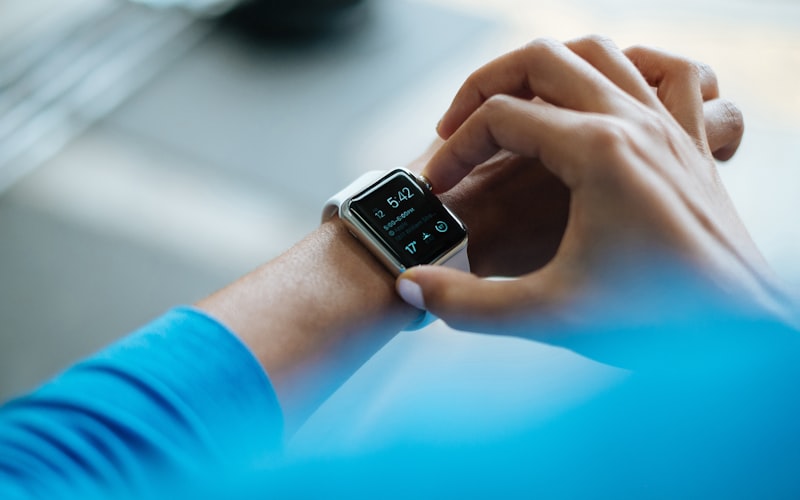
Much of what has been described here as sensation also exists as signal, and modern sensors can observe it. When the sympathetic system is active, heart rate variability, the subtle beat-to-beat fluctuation in the heart's rhythm, tends to fall, while resting heart rate, breathing rate and electrodermal activity tend to rise. When the body recovers, these measures move the other way.
None of these figures is a verdict on how a person feels, and no single reading means much in isolation. Their value lies in pattern and context over time. A worn device such as Aura Clarus builds a longitudinal baseline for each individual, so that a shift is interpreted against that person's own normal rather than a population average.
From numbers to awareness
Used well, this kind of feedback supports awareness rather than alarm. Noticing that recovery has been shallow across a stretch of demanding weeks can prompt earlier rest, gentler scheduling or a conversation that might otherwise have waited. The data is a mirror, not a diagnosis, and it is most useful when it helps a person listen to a body they might otherwise have overridden.
7. Listening Without Self-Diagnosing
Understanding the physiology of anxiety is empowering precisely because it is demystifying. The racing heart is not a heart attack. The tight chest is not necessarily illness. The churning gut is not a sign that something has gone irreparably wrong. In most cases these are the honest, if inconvenient, outputs of a protective system doing its job at the wrong moment.
That knowledge, however, is a starting point for awareness, not a substitute for professional judgement. Sensations that mimic anxiety can occasionally signal something that deserves medical attention, and it is not always possible to tell the difference from the inside. The goal is to become a more attentive observer of one's own body, not an anxious auditor of every heartbeat.
Where anxiety becomes persistent, severe, or begins to narrow a life, it deserves the same care and seriousness as any other health concern. Reaching out to a qualified professional is not a sign of weakness but a reasonable response to a system that has lost some of its flexibility. Effective help exists, it is widely available, and seeking it is among the most practical things a person can do. The body's alarm can be recalibrated, and no one has to work through that alone.
This article is published by Adarna Inc. for educational and informational purposes only. It does not constitute medical advice. Consult a qualified healthcare professional before making any health-related decisions.